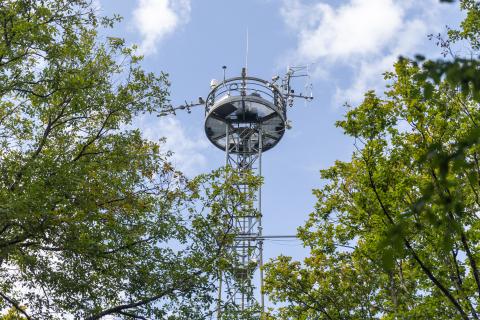
The Barbeau station, a research platform in the middle of a forest for monitoring the ecosystem
The Barbeau forest research station is a field-based research platform. For the past twenty years, it has been used to collect continuous data on the surrounding forest ecosystem, notably as part of the European Integrated Carbon Observation System (ICOS) research infrastructure. (This article was originally published in L'Édition n°28.)
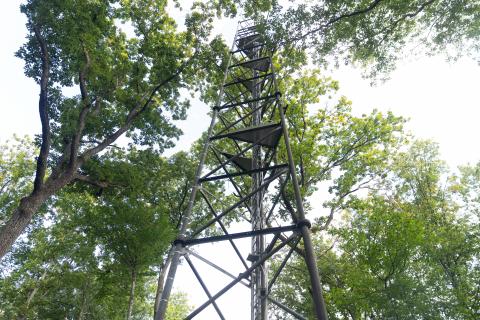
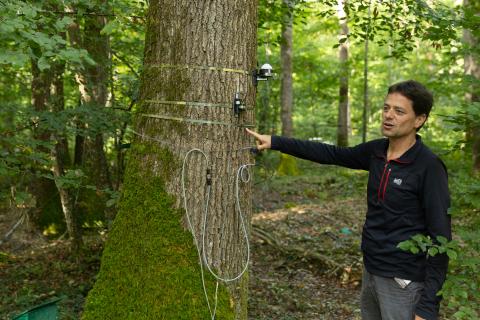
In the Barbeau state forest, located some ten kilometres from Fontainebleau in Seine-et-Marne, the trees are closely monitored. Trees such as this large oak whose trunk is fitted with various devices. Beneath a metal strip, two needles are stuck into the bark, just a few centimetres apart. "With this equipment, we can measure the flow of sap inside the tree," explains Daniel Berveiller, a research engineer at the Ecology, Society and Evolution laboratory (ESE, Univ. Paris-Saclay/French National Centre for Scientific Research, CNRS/ AgroParisTech). "We also have dendrometers to measure variations in trunk diameter." Just steps away is a far more impressive monitoring device: a metal tower soaring thirty-five metres above the canopy. This is the main facility for the Barbeau forest research station.
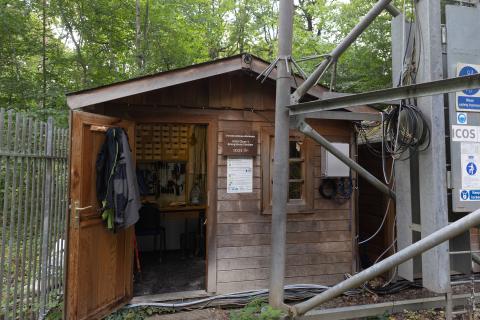
Managed by the ESE laboratory's Plant Ecophysiology group, this field-based scientific platform collects a wealth of data on the surrounding forest ecosystem, dominated by oaks and hornbeams. "The project was launched in 2003, but scientific activities only really began in 2005 with the installation of the tower. This year 2025, we're celebrating the station's twentieth anniversary!" says the scientist in charge of the platform.
Measuring flows of matter and energy in the ecosystem
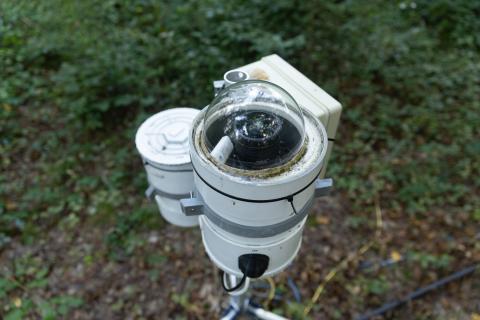
While it offers a breathtaking view of the forest, the metal tower is more than just an observation post. It is equipped with dozens of sensors so that it can make continuous measurements, known as turbulent covariance. This method involves calculating the flows of matter and energy between the forest ecosystem and the atmosphere. Among the instruments, "we have an IRGA (Infrared gas analyser) which measures carbon dioxide (CO₂) and water vapour concentrations in the air. This is combined with a three-dimensional ane-mometer that measures wind speed in three dimensions. This is the site's main device, which we use to calculate what enters the forest ecosystem by photosynthesis and what is released by respiration."
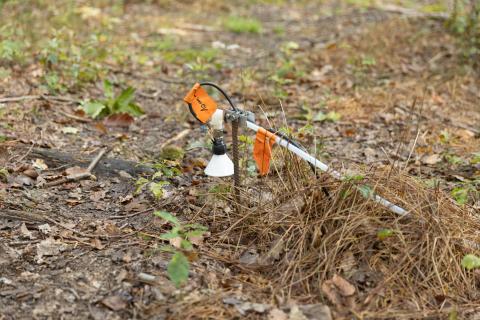
The system is supplemented with extensive meteorological data collected by sensors measuring temperature, humidity, rainfall and radiation, installed in the air at different heights and in the soil at various depths. "We also carry out energy balance to determine precisely how much energy is captured, absorbed and reflected by the vegetation," explains Daniel Berveiller. In total, more than 150 variables are collected continuously and in real time within the station area. In addition, scientists visit the site regularly to take measurements and samples with the aim of characterising the forest ecosystem.
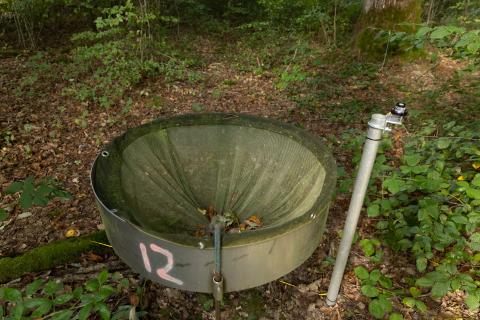
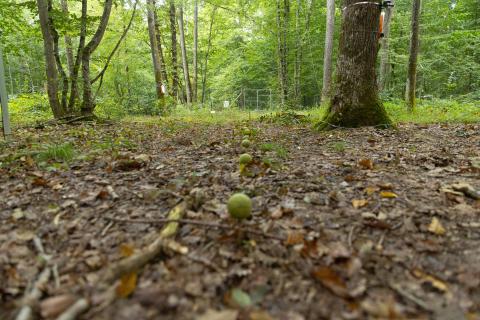
Not far from the aforementioned oak, a circular net-covered container fills up with leaves, branches and acorns shaken down by the wind. "This is what we call a litter trap. We'll soon collect its contents for processing and analysis." In mid-July, the team had already carried out its usual campaign of sampling leaves from mature trees. "These are sun leaves - which are found in the uppermost canopy - taken from twenty oaks and ten hornbeams." In addition to studying the flows of matter and energy, Daniel Berveiller and his
colleagues also examine the ecosystem's mass balance, which provides an overview of "the amount of carbon present in each compartment."
Voted best ICOS ecosystem station in 2025
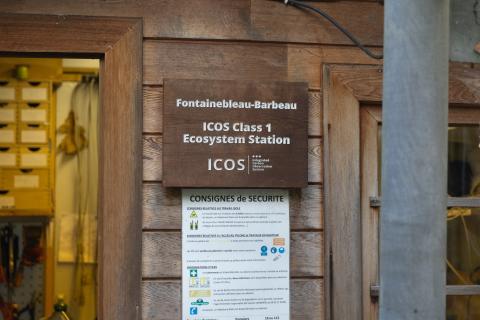
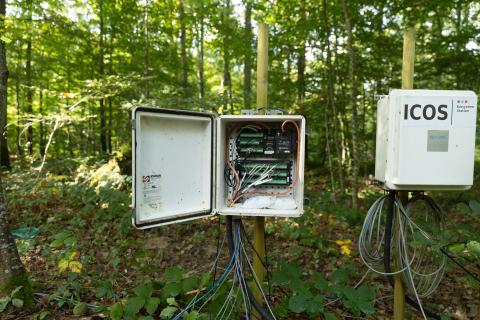
Although the Barbeau station was officially opened in 2005, its integration into the European ICOS (Integrated Carbon Observation System) research infrastructure, which aims to precisely observe and monitor greenhouse gas fluxes, has been a major turning point. "It seemed only right to join this infrastructure in order to improve data quality and skills, and expand our activities," explains the research engineer. "We were the first station to be awarded the "Class 1" label in 2019," which is the most demanding level in terms of ecosystem measurements and monitoring.
Twenty-one French research stations are currently part of the ICOS network, includ-ing sixteen focusing on "ecosystems". However, after six years of hard work, Barbeau has received a special distinction: it was awarded the 2025 Best ICOS Ecosys-tem Station Award. "We really weren't expecting it," confides Daniel Berveiller. "But we were proud because the whole team has invested a lot of energy in it. We're careful to follow protocols, instructions, etc." Using the data continuously collected by these platforms, the aim is to improve the representation of greenhouse gas fluxes in climate models.
In addition to ICOS, the Barbeau platform is involved in around ten research projects, two of which are led by scientists from the ESE laboratory. "We are also approached by international teams who want to carry out intersite comparisons with other stations in Europe or further afield." Over the past twenty years, new facilities have regularly been added around the huge tower. And activities are unlikely to stop any time soon. "The station has been accredited by ICOS for a twenty-year period, until 2039," confirms the coordinator.
- Barbeau forest research station website: https://barbeau.ese.cnrs.fr/

This article was originally published in L'Édition n°28.
Find out more about the journal in digital version here.
For more articles and topics, subscribe to L'Édition and receive future issues: