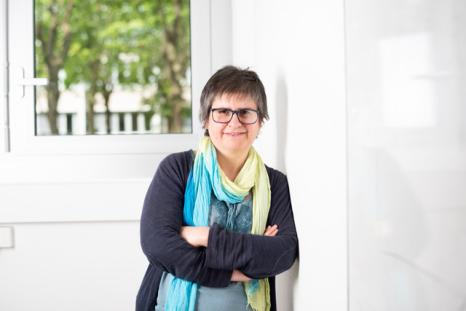
Sara Bolognesi: exploring the invisible, from the Higgs boson to neutrinos
Sara Bolognesi is a physics researcher at the Department of Particle Physics – DRF/Irfu (DPhP – Univ. Paris-Saclay/CEA). She is a specialist in standard model physics and neutrinos, and is interested in the fundamental interactions and symmetries that underlie the structure of matter and the universe. Deeply committed to the experimental dimension of her discipline, she is convinced that major discoveries are always the result of collective work.
Nothing predestined young Sara Bolognesi, a high school student in Turin, to pursue a career in physics. After studying literature, she discovered physics through popular science books recommended by her philosophy teacher. "I realised that mathematics offered a language for understanding the world," says the researcher. She was fascinated by physics' ability to describe the invisible and chose to study the subject at the University of Turin. During an internship at CERN, the European Organisation for Nuclear Research, she was captivated by the international, open and collaborative environment. This was a second "turning point" that steered her career towards experimental physics and led her to defend a thesis in 2008 on the calibration of muon detectors and the study of the Higgs boson by the CMS (Compact Muon Solenoid) detector installed on the Large Hadron Collider (LHC) at CERN.
CERN and the discovery of the Higgs boson: a physicist's dream
During her PhD and then her post-doctorate at CERN, Sara Bolognesi immersed herself in the most significant collective adventure in contemporary physics. Involved in the CMS experiment, she participated in the analyses that led, in 2012, to the discovery of the Higgs boson — a particle long predicted by theory and essential to understanding the origin of the mass of elementary particles. "This period was a turning point and a moment of immense collective joy. The work of several generations of physicists had finally come to fruition." With this major milestone achieved, Sara Bolognesi decided not to stop there. "I very quickly felt a need for intellectual renewal, a desire to embark on a new adventure that would lead me to other mysteries to discover." This aspiration prompted her to open herself up to new opportunities, even if it meant turning to other fields of physics.
A new start at CEA Paris-Saclay: the neutrino challenge
At the end of 2013, the researcher heard about a vacancy in neutrino physics at CEA Paris-Saclay, within the Particle Physics Department (DPhP) of the Institute for Research into the Fundamental Laws of the Universe (Irfu). As I knew nothing about this field, I would probably have rejected my application if the laboratory had not explicitly stated that it was open to physicists from other backgrounds." She took a chance, successfully, and moved with her husband to the Paris region. Upon her arrival, she joined the T2K (Tokai-to-Kamioka) experiment in Japan, which studies the oscillations of neutrinos—these elusive particles, among the most abundant in the universe but also the most difficult to detect. "It was a complete change of logic. After years at the LHC, where you have to choose which events to keep from among billions of collisions, I found myself in a field where every event counts and where you keep everything!" It was a challenging change for the researcher. "I had to learn everything all over again. But it was exactly what I needed," she recalls.
Measuring the elusive: the physics of near detectors
Within T2K, a neutrino beam is produced in a particle accelerator in Tokai and then sent more than 295 kilometres to a gigantic underground detector in Kamioka. Located between the two, in close proximity to the source, there is a set of instruments called a "near detector": this is where Sara Bolognesi works. "These detectors measure neutrinos immediately after their creation, or more precisely the particles they give rise to when they interact with matter," explains the researcher. It is by studying these indirect traces of neutrinos that physicists determine their number, energy and behaviour. These measurements are essential for better interpreting the signals observed further away, refining the physical models that describe their behaviour and improving the accuracy of future experiments.
Towards the next neutrino revolution
One of the future experiments Sara Bolognesi is already looking forward to is Hyper-Kamiokande, the successor to T2K, which promises major new advances. "With T2K, we have achieved remarkable precision, but to cross the threshold of discovery — the famous '5 sigma' — we need more powerful beams and even larger detectors." Hyper-Kamiokande is eight times more massive than its predecessor and aims to explore the violation of charge-parity (CP) symmetry in neutrinos. If this violation is confirmed, it would explain why the universe is composed of matter rather than antimatter. "In neutrino physics, we know that the next ten to fifteen years will be decisive. It's very exciting to embark on this adventure and hope to contribute – before I retire! – to one of the greatest mysteries in cosmology today," says the physicist.
The strength of the collective
Throughout her career, Sara Bolognesi has held numerous positions of responsibility within the T2K collaboration: first as scientific leader of the group responsible for measuring cross sections, then for modelling them, before taking on the role of physics coordinator for the entire project. These roles, at the crossroads of science and human relations, have given her a broader vision of research: "We don't just do physics, we learn to build a collective." She particularly emphasises the richness of working alongside the engineers and technicians at the CEA, with whom the new detector near T2K, equipped with innovative technologies, was designed. "They are all passionate experts without whom nothing would be possible." Doctoral students are also an integral part of this collective. "I consider them to be true collaborators. It is very often thanks to them that I wake up feeling enthusiastic," she adds. In her view, it is in these constant exchanges between researchers, engineers and students that the key to progress lies. "Great discoveries are never the work of one person: they are born of a community that patiently builds knowledge."
The importance of work-life balance
Alongside her scientific responsibilities, Sara Bolognesi became the mother of three adopted children in the midst of the Covid-19 pandemic. "I had doubts about my ability to juggle everything. It was my managers who convinced me that I could do it. I owe them a lot, as well as all the inspiring figures and role models who have marked my career," she says. This experience has profoundly influenced her thinking about the balance between personal and professional life. It is an issue that, in her view, concerns the entire research community. "We need to learn to value different rhythms and different ways of investing ourselves. I am convinced that scientific creativity is also nourished by everything we experience outside of research," she concludes.